The readers of this page know very well that I am big into movies, specially those that can be interpreted with the lens of spiritual awareness. I watched 2 movies during the New Year Holidays, that I want to discuss with you today. I mean, I watched more than 2 movies but only 2 are worth discussing here. 🙂
I recommend you watch these movies first, otherwise my discussion won’t make much sense. These are After Yang and 3-Iron.
First, let’s dive into the movie After Yang. It’s supposed to be a science fiction movie but I think it has multiple layers of spiritual connotations to it. The movie itself feels like a zen koan. Very slow paced and basically, no meaningful event happens in the movie after Yang breaks down. But the movie asks us what it means to be human. What’s the point of everything? What’s the point of us being human? Why is there something instead of nothing?
Yang is supposed to be the bot (cultural techno) but it feels like Yang is more human than the human characters. The protagonist (Colin Farrell) is sleepwalking his life, going to job, missing out daughter’s important events, not enjoying the meals, or appreciating the daughter’s growth. The bot, on the other hand, is alive and present at every moment. His memory space is limited but is filled with little miracles of existence such as sunlight falling on leaves, enjoying the preparation of tea, and a few people he deeply cared for. We humans, on the other hand, miss all these miracles of everyday life in the pursuit of frivolous superficial fake-metrices such as money, prestige, or power that will all be vain when we die.
The movie also questions about mortality. If you die, does it even matter what you do when alive? If you die, what happens after you die? As a bot, Yang knows he is going to die one day. We know that our computers, phones, TV, any devices that we own- will die one day. But we don’t appreciate that we also die one day. I mean, we know it, but we don’t appreciate this as a fact. Even when people close to us die, we feel sorry for them, as if the same fate won’t befall us anytime soon. Yang knows he will die one day, so prioritizes his time and memories on things that he wants to stay in his chip long after he is gone. What about us? What do you think will be your fond memories in your death bed? Or if science was able to extract your chip after death and the memories were played on a TV screen, what do you think will show up? Have you collected enough memories in your chip to last for a 2-hour movie? Will it be a good movie?
This lack of acceptance of mortality is an interesting characteristic of us humans. Even when everyone around us is dying, we fail to accept that that’s our fate too. Even when we do, we want to find comfort concocting stories about lives after death. Don’t get me wrong, I am not claiming that there is no afterlife. If you believe in it, there is. If you don’t, there isn’t. What I am saying is, if you are unsatisfied with your current life or are unable to live your current life to the fullest, what are you going to do with your afterlife? Suffer more? Just accept your life as it is, live it to the fullest, and when you die, you die. Such has become our fate lately that we neither live fully and even in death, we can’t even die fully. Live fully, die fully. When you die, you die.
This brings me to the next movie I watched. It’s a Korean movie called 3-iron. Again, the readers of this website know by now what a big fan I am of the director Kim Ku-duk. I have watched almost all of his movies, and my favourites are spring, summer, fall, winter…and spring again, Human, Space, Time and Human, 3-iron, and The Bow. You should watch all of these. Kim has passed away in 2020 from Covid, so unfortunately, we won’t get any new movies from him.
This was not my first time watching 3-iron. Every time I watch it, I feel like I understand it a bit more. There is very little dialogue in this movie. There is no conversation between Tae-suk and Sun-hwa throughout the movie, but there is a deep connection between them. There are a lot of symbolisms in this movie. The empty houses symbolize modern alienation and spiritual vacancy. There are several and even affluent items in the houses, but none of the families living in these houses seem happy. Even the items in the houses aren’t very well cared for-such as the broken watches. The houses have items but are in essence, void. Tae-suk fills these voids not by possessing but by caring- fixing watches, watering plants.
Tae-suk in my view is a modern day practitioner of Zen. He lives freely. He doesn’t possess anything except for his motorbike. He goes to these houses and lives there as if he is the owner, taking care of the house and paying his rent through washing clothes and fixing items. Why does he wash clothes manually even if there is a laundry machine? Well, the point is not to get the clothes clean. The point of washing clothes is to wash the clothes. And the fact that he has no “home” represents impermanence. Nobody actually is a permanent owner of any home in real sense- we don’t even own our bodies forever. There is no point in getting attached to any home. And even when he doesn’t possess these homes, he still waters the plants and fixes watches. Death doesn’t faze him. When he enters a house where the old man has died, he performs a proper burial and then goes about eating and living life.
Sun-hwa’s abusive marriage symbolizes samsara. Samsara is complex and is a cyclical entrapment. Her husband is abusive, but is also sometimes loving enough, powerful enough, and wealthy enough to keep her in the entrapment. She doesn’t like her marriage but doesn’t see a way out (read: without a master or mentor or guru, you don’t see an escape from samsara). Tae-suk becomes her bodhisattva who frees her without words.
Tae-suk’s use of the 3-iron golf club represents a tool for precision without force. He practices everyday. Not because he is participating in a tournament, but just because. This is symbolic of practicing detachment and awareness without any goals of being happy or enlightened, but just because. The point of practice is to practice. At the end, his practice of becoming invisible represents the ultimate practice of being without being. Existing without an ego. The dissolution of ego removes the artificial boundary between the subject and the object. It’s the ego that’s now invisible. You exist and yet, “you” don’t exist. The funny thing is that you have never existed in the first place. So when you practice becoming invisible, it’s not a practice to take away something. It’s a practice to unbecome someone that you never were in the first place, you only pretended that you existed or were visible.
This neatly ties into the final union between Tae-suk and Sun-hwa while Sun-hwa continues to live with her abusive husband. As said, Sun-hwa living with her husband represents Samsara. At the end, she realizes- through the help of Tae-suk whose ego is now dissolved- that she cannot escape Samsara and seek Nirvana. Nirvana co-exists with Samsara. You cannot find salvation by renouncing the world. Anyone could go to a mountain top and stay alone and claim they have achieved peace. If real, you should be amidst the chaos of the world, deal with everyday human drama, and still not lose your awareness. Enlightenment is abiding non-dual awareness. Not a transient feeling of happiness when you are alone or without needing to face the world.
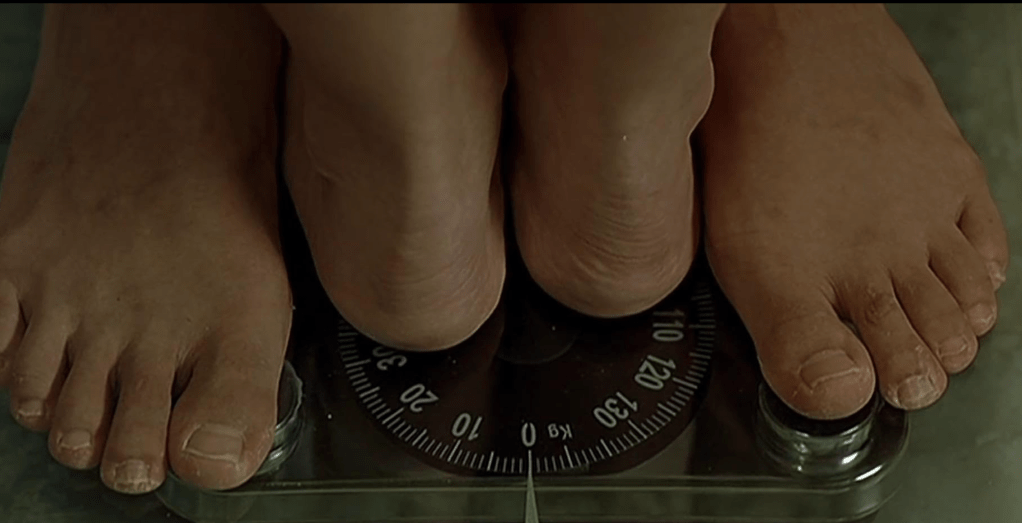
So, in my opinion, this is the most divine love story ever portrayed on cinema. A bodhisattva already on his path to enlightenment faces final tests through love, separation, police, prison, etc. which encourages him for the final practice of ego dissolution and becoming invisible. He then guides Sun-hwa who can now find nirvana amidst samsara. Both of them have dissolved away, the egos have melted, and the subject-object distinction has disappeared. That’s why the weight of them together, at the end, reads as zero.

 Bishal Gyawali
Leave a comment